

Motion Complete Guide
Detailed Notes, Formulas, Diagrams, Examples & Exercises
📚 Contents
1. Introduction to Motion
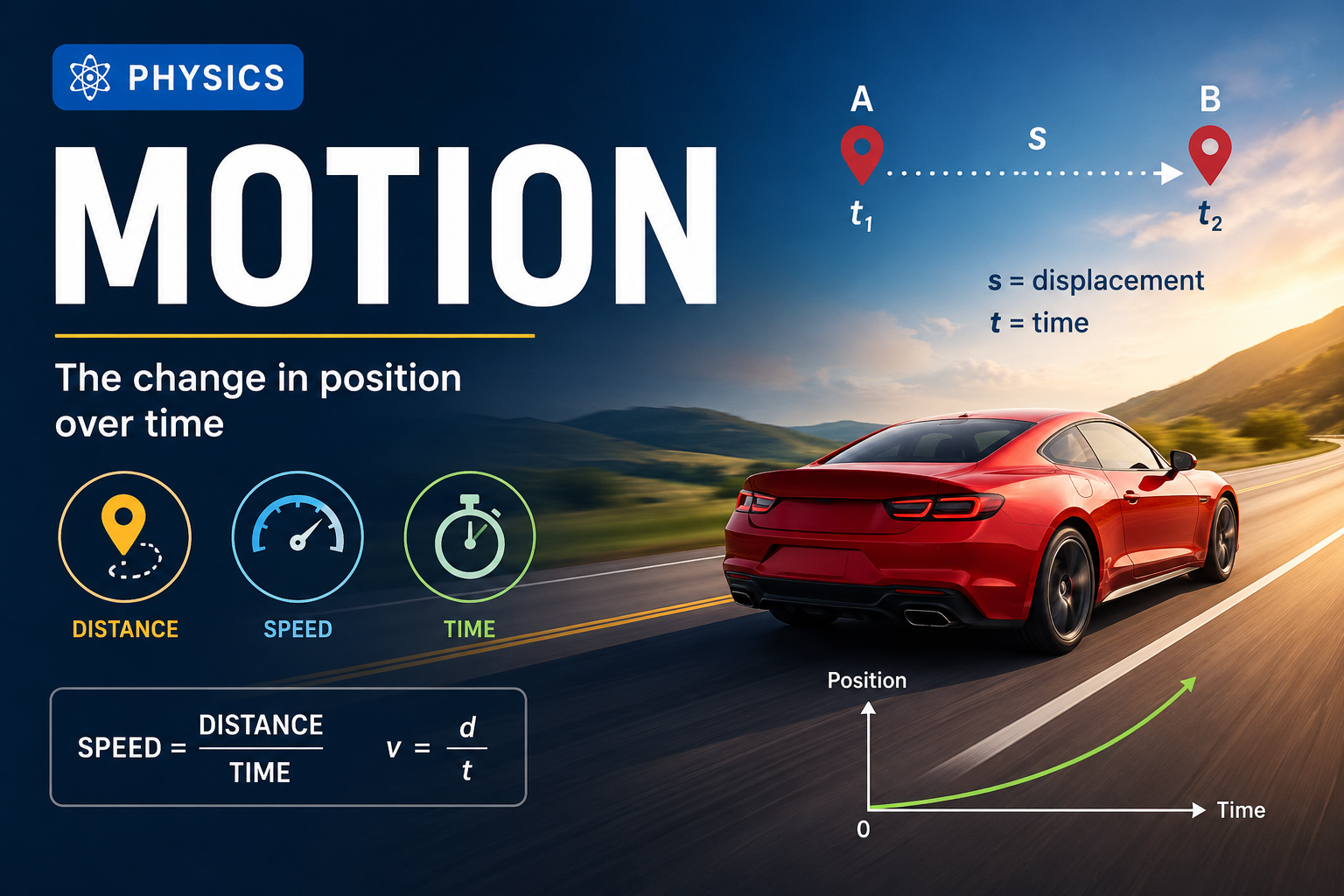
When an object changes its position with time, it is said to be in motion.
Motion = Change in Position with Time
Examples:
- Moving car
- Flying bird
- Rotating fan
- Earth revolving around the Sun
2. Types of Motion
1. Rectilinear Motion
Motion in a straight line.
Example: Train moving on a straight track.
2. Circular Motion
Motion in a circular path.
Example: Ceiling fan.
3. Rotational Motion
Motion around its own axis.
Example: Spinning top.
4. Periodic Motion
Motion repeated at equal intervals.
Example: Pendulum.
3. Distance and Displacement
| Distance | Displacement |
|---|---|
| Total path covered | Shortest path between two points |
| Scalar quantity | Vector quantity |
| No direction | Has direction |
A person walks 5 m east and then 3 m west.
Distance = 5 + 3 = 8 m
Displacement = 2 m east
Displacement = 2 m east
4. Speed and Velocity
Speed
Distance travelled per unit time.
Speed = Distance / Time
v = s/t
Velocity
Displacement per unit time in a specific direction.
Velocity = Displacement / Time
Average Speed
Average Speed = Total Distance / Total Time
SI Unit
m/s (meter per second)
A car travels 120 km in 3 hours.
Find speed.
Speed = Distance / Time
= 120 / 3
= 40 km/h
= 120 / 3
= 40 km/h
5. Acceleration
Rate of change of velocity is called acceleration.
Acceleration = Change in Velocity / Time
a = (v-u)/t
| Symbol | Meaning |
|---|---|
| u | Initial velocity |
| v | Final velocity |
| a | Acceleration |
| t | Time |
Velocity changes from 10 m/s to 30 m/s in 5 s.
Find acceleration.
a = (v-u)/t
= (30-10)/5
= 20/5
= 4 m/s²
= (30-10)/5
= 20/5
= 4 m/s²
6. Equations of Motion
First Equation
v = u + at
Second Equation
s = ut + ½at²
Third Equation
v² = u² + 2as
Fourth Equation
s = [(u+v)/2] × t
A body starts from rest and accelerates at 2 m/s² for 5 s.
Find final velocity.
v = u + at
u = 0
v = 0 + 2×5
v = 10 m/s
u = 0
v = 0 + 2×5
v = 10 m/s
Find distance travelled in above question.
s = ut + ½at²
= 0 + ½×2×5²
= 25 m
= 0 + ½×2×5²
= 25 m
7. Motion Graphs
Distance-Time Graph
Shows how distance changes with time.
Velocity-Time Graph
Area under graph gives displacement.
8. Motion Under Gravity
Objects falling freely experience acceleration due to gravity.
g = 9.8 m/s²
Equations Under Gravity
v = u + gt
h = ut + ½gt²
v² = u² + 2gh
A ball is dropped from rest for 3 seconds.
Find final velocity.
v = u + gt
= 0 + 9.8×3
= 29.4 m/s
= 0 + 9.8×3
= 29.4 m/s
9. Circular Motion
Motion along a circular path is called circular motion.
Speed = 2πr / t
A wheel of radius 0.5 m completes one rotation in 2 s.
Find speed.
Speed = 2πr/t
= 2×3.14×0.5 / 2
= 1.57 m/s
= 2×3.14×0.5 / 2
= 1.57 m/s
10. Practice Exercises
Exercise 1
A car travels 150 km in 5 hours. Find speed.Speed = Distance / Time
= 150/5
= 30 km/h
= 150/5
= 30 km/h
Exercise 2
A body accelerates from 5 m/s to 25 m/s in 4 s. Find acceleration.a = (v-u)/t
= (25-5)/4
= 5 m/s²
= (25-5)/4
= 5 m/s²
Exercise 3
A body starts from rest with acceleration 3 m/s². Find velocity after 6 s.v = u + at
= 0 + 3×6
= 18 m/s
= 0 + 3×6
= 18 m/s
Exercise 4
Find distance travelled by above body.s = ut + ½at²
= 0 + ½×3×6²
= 54 m
= 0 + ½×3×6²
= 54 m
🎯 Quick Formula Revision
Speed = Distance / Time
Velocity = Displacement / Time
a = (v-u)/t
v = u + at
s = ut + ½at²
v² = u² + 2as
g = 9.8 m/s²
© Complete Motion Physics Learning Webpage